KNOW WHENTO PUSH.AND WHEN TO REST.
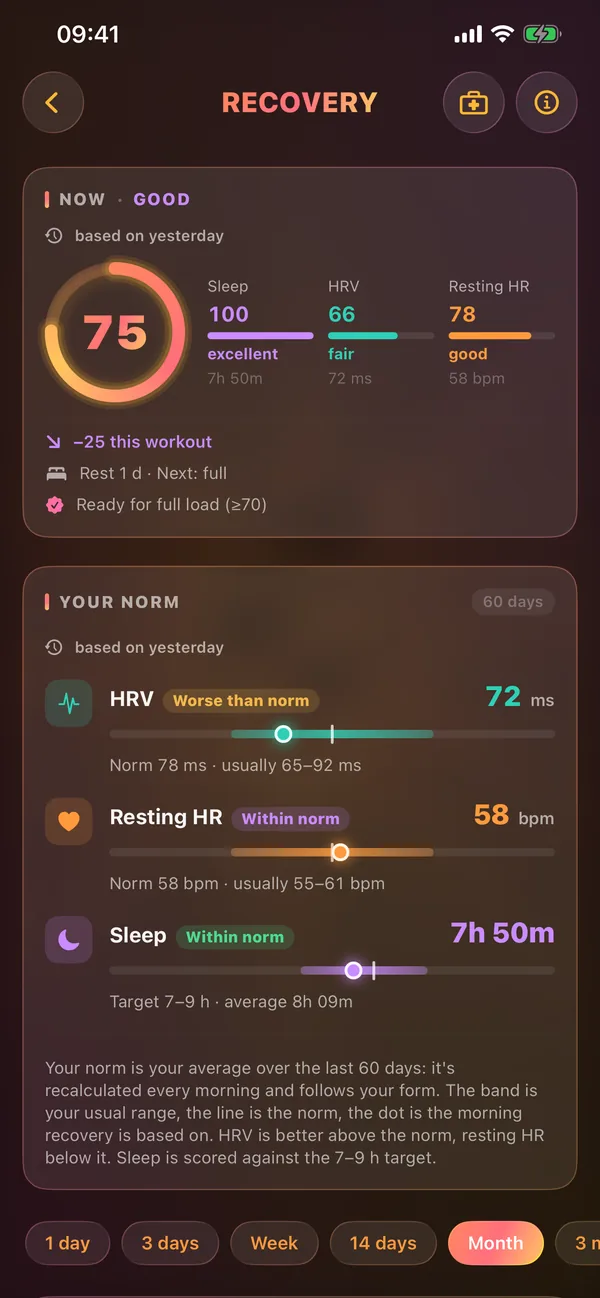
A daily readiness score from sleep, HRV and resting heart rate against your own 60-day norm, the live cost of each workout, a radial muscle tree and long-range trends. Every formula is explained in the app.
Build a readiness
score.
Change last night's sleep, your morning HRV and resting heart rate, then add a workout. The weights, norm scoring and training cost are the app's own.
Simplified: sleep is scored on duration here; the app also uses efficiency and deep + REM share. Training cost = 50 · (1 − e^(−strain / 120)), fading on a 24-hour curve.
Six lenses on
one body.
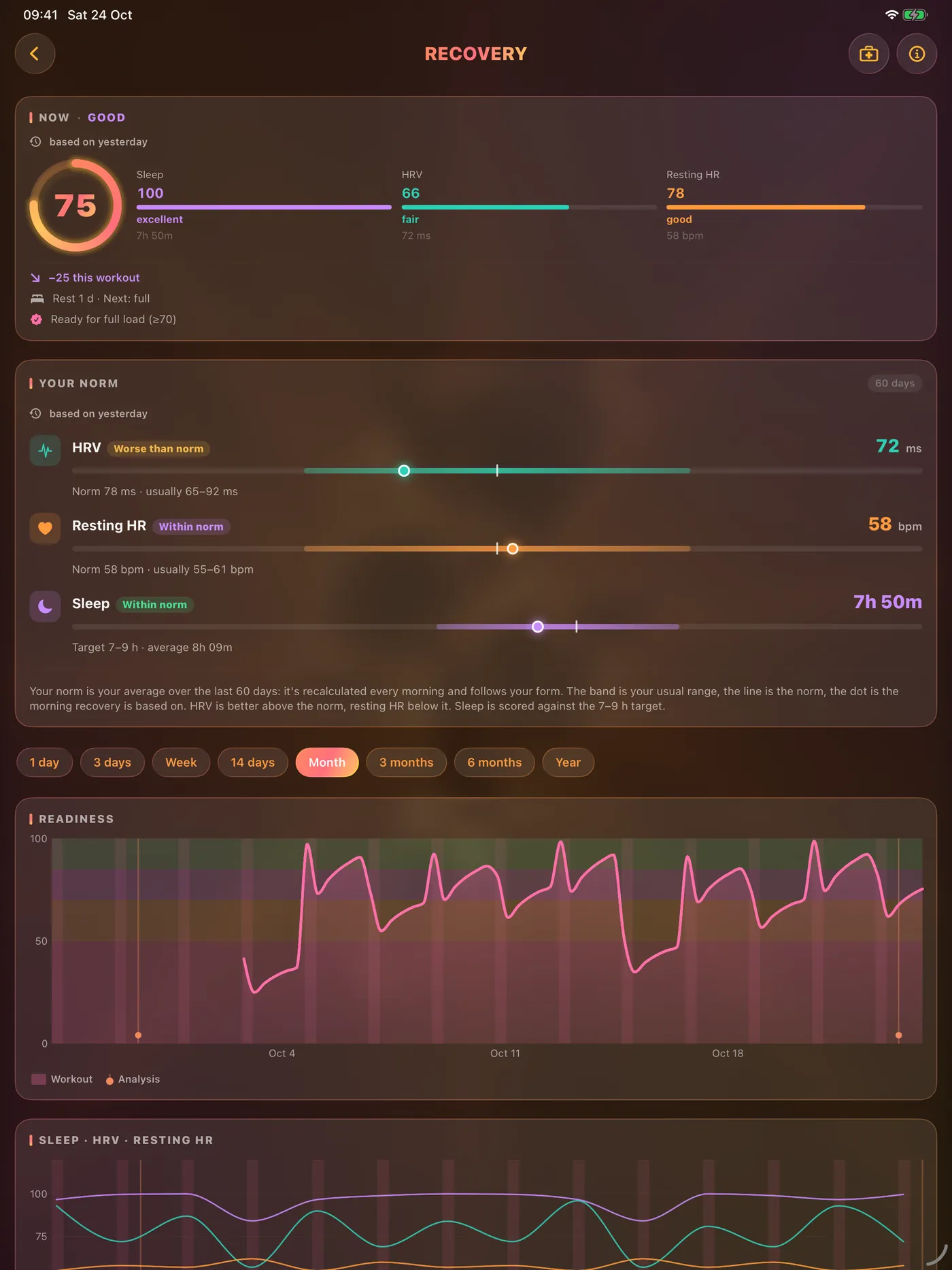
Your norm, not a stranger's average
HRV and resting heart rate are scored against your own trailing 60 days. A workout lowers readiness live, then it recovers on a 24-hour curve.
- Readiness, sleep, HRV and resting HR on one chart, from 1 day to a year
- Workouts, illness and lab dates drawn on the same timeline
- The same number on the Hub, widgets, Apple Watch and workout screen
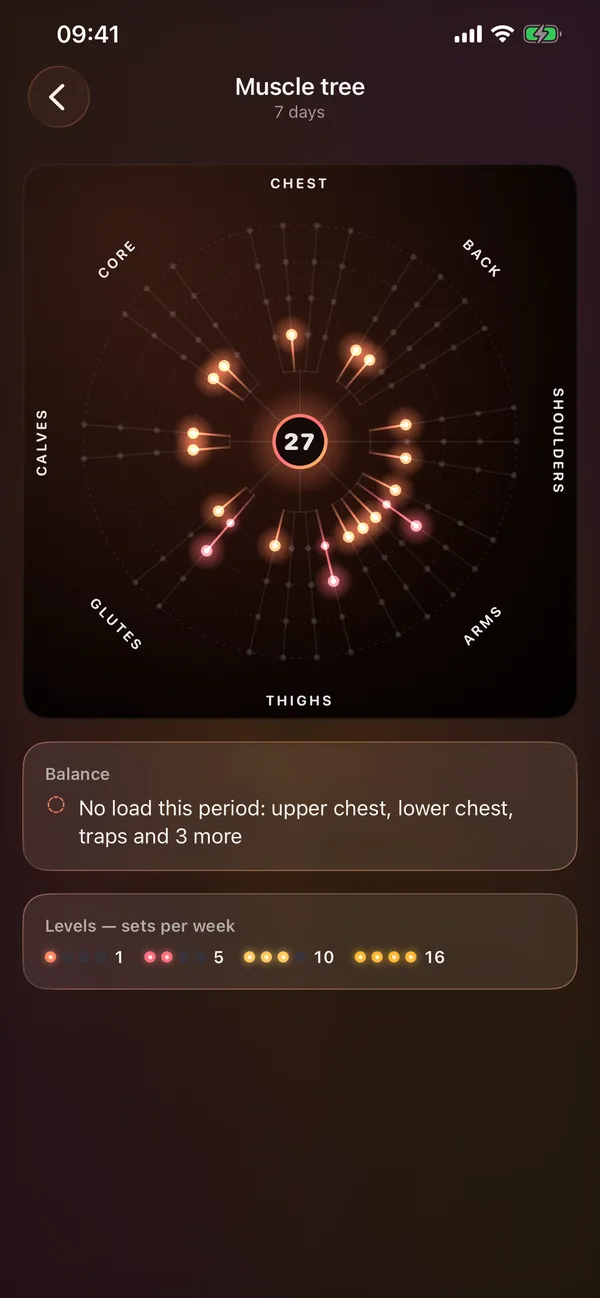
See what you trained, and what you skipped
Eight rays, 25 muscles and four levels from 1 to 16 sets a week. Secondary muscles count as half a set.
- Balance hints: untouched muscles, push versus pull, share of leg work
- Pinch to zoom, tap a branch to see the exercises behind it
- A body atlas with 27 zones and recovery hours per muscle
Weeks, months, a whole year
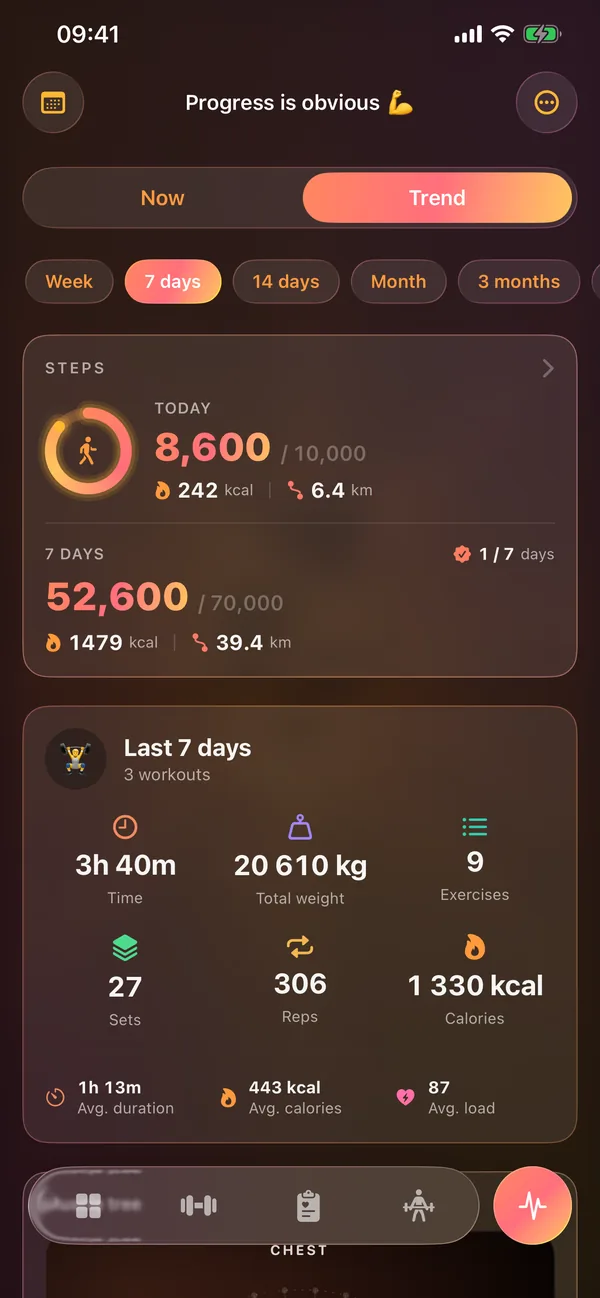
Time, total weight lifted, sets, reps, calories and training load for any period, each with a trend line.
- Activity heatmap for workouts, lab analyses and supplements
- Training load as Banister TRIMP from Apple Watch heart rate
- Sleep and training compared, labelled as association, not cause
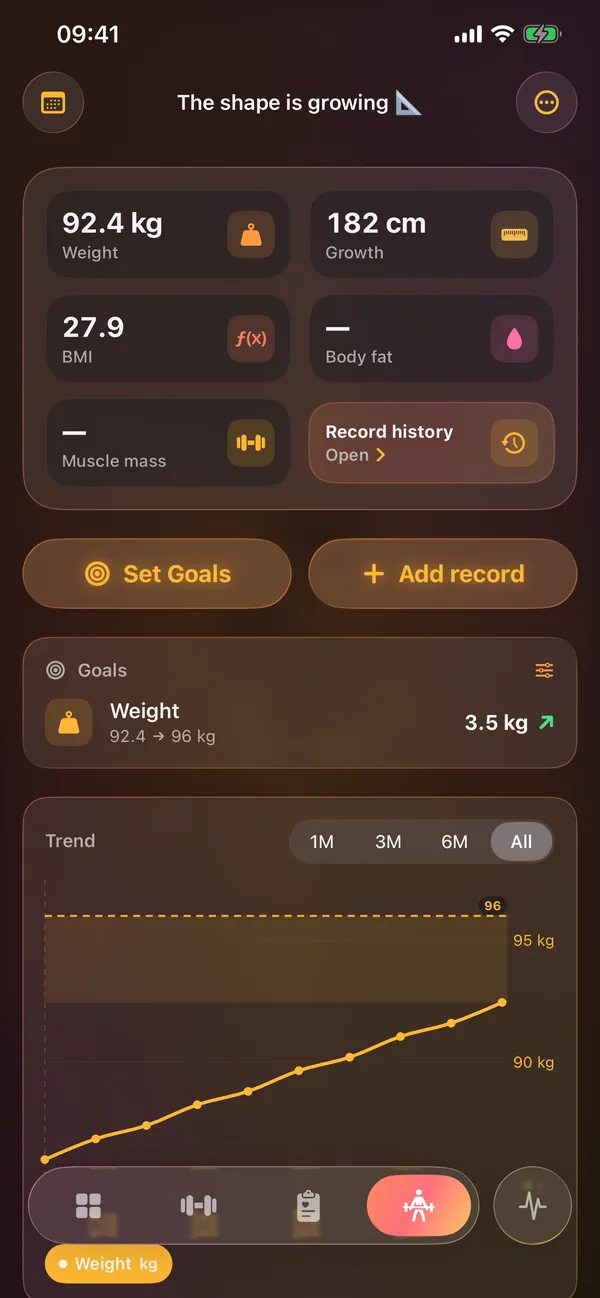
Measurements and goals
17 body metrics, a goal line on the chart and a base-versus-now comparison on a 3D body figure.
- Weight, body fat, muscle and girths, left and right separately
- Max weight and volume chart for every exercise
- A goals card with distance to go and a trend arrow
Formulas,
not black boxes.
Duration, efficiency, deep + REM
Weighted 50 / 25 / 25. Also sleep debt against an 8-hour need and a regularity score.
Felt during the session
Readiness drops live while you train and recovers on a 24-hour curve. No watch required.
Per zone, in hours
Fatigue from each set fades over about 30 hours. Rule-based tips: go lighter, fewer sets, or switch the day.
Banister TRIMP
From Apple Watch heart rate with sex-specific coefficients, or from weight and sets without a watch.
Spearman r, honestly
Sleep against volume, load, calories or duration, shown only after 8 paired sessions.
Recovery at a glance
A recovery widget with the readiness ring, sleep, HRV and resting HR, and the cost of your last workout.
Bigger screen,
same numbers.
NOTEReadiness is a planning guide built from your own baseline, not a medical indicator.
Questions,
answered.
Is the readiness score a medical measure?
No. It's a planning guide built from your own baseline, not a medical indicator.
Do I need an Apple Watch?
Sleep, HRV and resting heart rate come from a wearable through Apple Health. Training load, the muscle tree and progress work from your logged sets alone.
Does any of this use AI?
No. Every number is a fixed, documented formula that runs on your device.
Why is my score different from another app's?
Riseform compares you with your own last 60 days, not with population averages, and shows exactly how each signal moved the score.
On your device.
Nowhere else.
There is nothing to sign up for, not even an email. Open the app and train.
No ads, no analytics, no third-party SDKs. App Privacy on the App Store: Data Not Collected.
Optional sync through your own private iCloud, plus .gymbak backups and full XLSX export.
YOUR GYM.
YOUR RULES.
YOUR DATA.
Offline. Private. No accounts required.
Built for iPhone, iPad and Apple Watch. iOS 26+. Zero third-party dependencies.